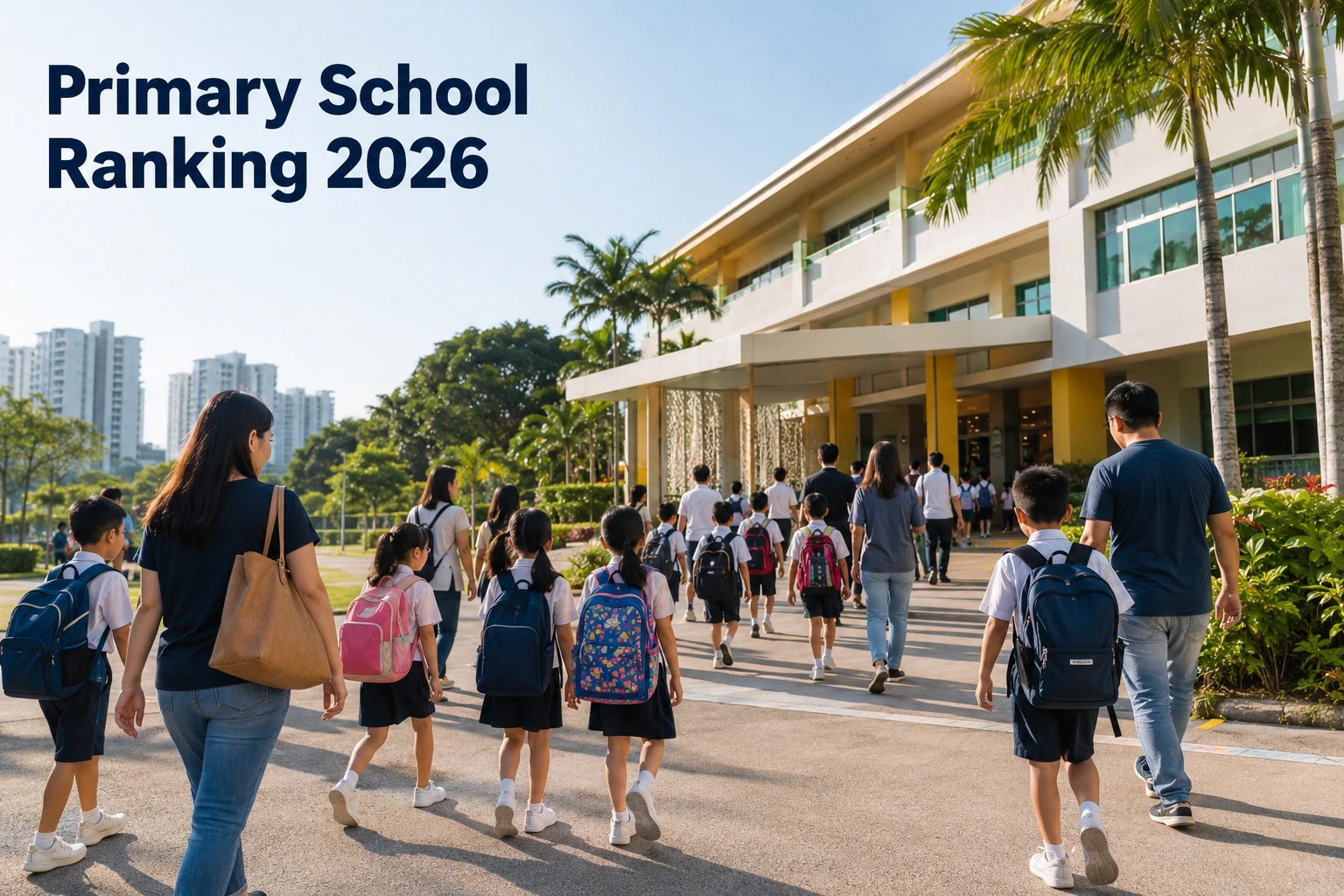
Primary School Ranking Singapore 2026: Top Schools & P1 Data
Searching for a primary school ranking in Singapore can bring up very different results. Some lists focus on PSLE performance, while others look at P1 registration demand, applicants per vacancy, balloting, school programmes or location. There is no single official MOE league table that ranks every school from #1 onwards, so a school’s position can change depending on the method used. For parents comparing primary schools Singapore, the useful part is knowing what each ranking actually measures. This Singapore primary school ranking uses current school and P1-related data to compare popular and high-demand schools, while also looking at the factors that can affect school choice. A ranking is a starting point, not the whole decision.
TL;DR: Primary School Ranking Singapore
There is no single official primary school ranking from MOE that places every Singapore primary school in order. Schools can rank highly based on PSLE performance, P1 registration demand, applicants per vacancy, school programmes, popularity or other measures. Parents should compare academic results, P1 competition, balloting, location and programmes rather than relying on one number. High P1 demand shows strong parent interest, but it does not automatically make a school the best fit for every child.
What Does Primary School Ranking Mean in Singapore?
A primary school ranking Singapore search can point to different types of school comparisons. There is no single number that tells parents which school is best, so it helps to know what the ranking measures.
Academic Ranking
A PSLE ranking may focus on PSLE performance and academic results, often highlighting high-performing primary schools.
Popularity Ranking
Popularity rankings look at parent demand, school popularity and registration interest. Schools that attract many families may appear higher on these lists.
Admission Competition
P1 competition looks at applicants, available vacancies, applicants per vacancy and balloting. A higher ratio can signal stronger demand for places. But a popular school is not automatically the best school for every child. For primary school admission, parents should also consider location, programmes and their child’s needs.
Top Primary Schools in Singapore Based on Current Data
For a practical primary school ranking 2026, P1 registration demand gives parents a useful way to compare current interest. The table below ranks schools by their final Phase 2B applicants-to-vacancy ratio for the 2026 P1 exercise, which is for children entering Primary 1 in 2027. It is not an official MOE league table and does not claim that one school is better than another. Instead, it shows where demand was strongest at this stage of registration. MOE data reported in July 2026 showed 33 oversubscribed schools, with 31 going to ballot. Nanyang Primary School had 52 applicants for 20 places, while Ai Tong School had 51 for 20.
| Rank | Primary School | Key Strength | P1 Demand |
| 1 | Nanyang Primary School | Strong demand and established reputation | Very High |
| 2 | Ai Tong School | Strong demand and school programmes | Very High |
| 3 | Pei Hwa Presbyterian Primary School | High demand and established profile | Very High |
| 4 | Holy Innocents’ Primary School | Strong P1 registration demand | Very High |
| 5 | Kong Hwa School | High demand and established reputation | Very High |
| 6 | Nan Hua Primary School | Strong demand and academic profile | Very High |
| 7 | CHIJ St. Nicholas Girls’ School (Primary Section) | Strong demand and programmes | Very High |
| 8 | Tao Nan School | High demand and established reputation | Very High |
| 9 | St. Joseph’s Institution Junior | Strong registration interest | High |
| 10 | Maris Stella High School (Primary Section) | High demand and established programmes | High |
The current figures put Nanyang at 2.60 applicants per vacancy, Ai Tong at 2.55, Pei Hwa Presbyterian at 2.19, Holy Innocents’ at 2.14 and Kong Hwa at 2.11. St. Joseph’s Institution Junior and Maris Stella High School also recorded strong ratios of 1.98 and 1.94. These figures show P1 competition, not a complete measure of school quality. Location, programmes, academic indicators, affiliation and actual admission eligibility still matter when comparing popular primary schools in Singapore.
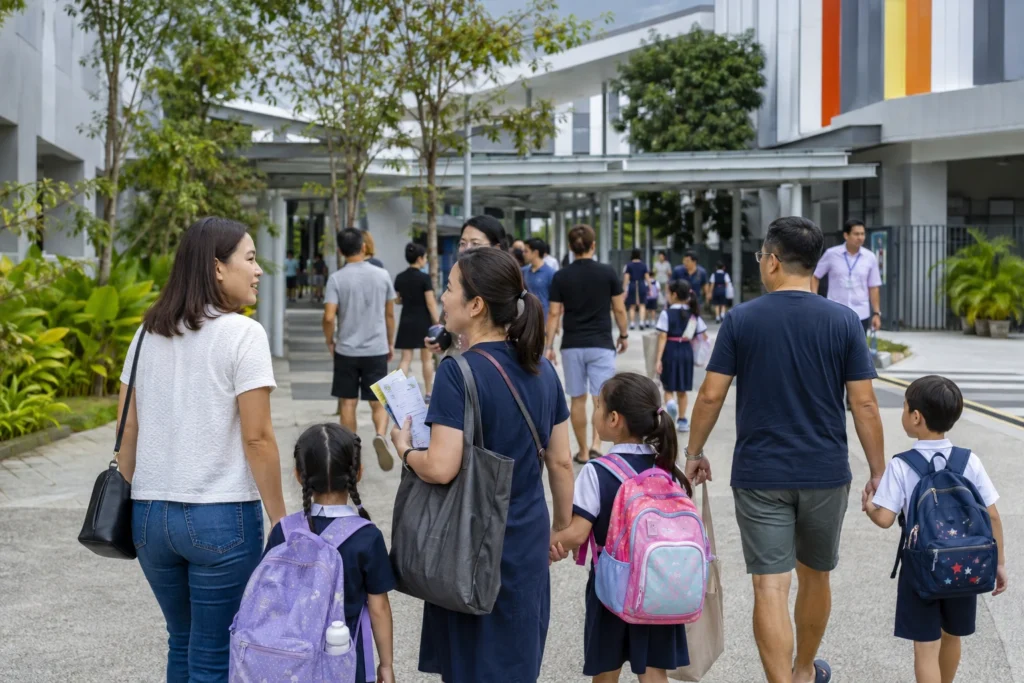
Primary School Ranking by P1 Competition
For parents tracking P1 registration, applicants per vacancy is a simple way to see how competitive a school is. The calculation is straightforward: applicants per vacancy = number of applicants ÷ available vacancies. A higher ratio generally means more families are competing for each available place during that registration phase.
| Primary School | Applicants | Vacancies | Applicants per Vacancy |
| Nanyang Primary School | 52 | 20 | 2.60 |
| Ai Tong School | 51 | 20 | 2.55 |
| Pei Hwa Presbyterian Primary School | 46 | 21 | 2.19 |
| Holy Innocents’ Primary School | 30 | 14 | 2.14 |
| Kong Hwa School | 38 | 18 | 2.11 |
These figures show why some primary school vacancies are more competitive during P1 balloting. But the ratio only describes demand for that particular registration phase. It does not prove that a school offers better teaching or is the right choice for every child. Parents comparing the most competitive primary schools Singapore should also check admission eligibility, distance, school programmes and the latest MOE information before making a decision.
How Primary School Rankings Are Calculated
There is no single primary school ranking methodology used across Singapore, so different websites may place the same school at different positions. The ranking criteria depend on the data being measured. A useful school comparison Singapore approach looks at several signals instead of relying on one score.
| Ranking Factor | What It Shows |
| PSLE performance | Academic outcomes |
| P1 demand | Parent interest |
| Applicants per vacancy | Admission competition |
| Balloting | Demand exceeding vacancies |
| School programmes | Learning opportunities |
| Location | Practical suitability |
| CCAs | Student interests |

PSLE performance can show academic results, while P1 demand and school demand give a clearer picture of parent interest. Applicants per vacancy can indicate admission pressure, while balloting happens when demand exceeds available places. School programmes, CCAs and school location add useful context that numbers alone cannot show. A strong ranking should bring these factors together rather than treating one measure as the final answer.
Does a Higher Primary School Ranking Mean a Better School?
A high position in a primary school ranking does not automatically mean the school is better for every child. Popularity and quality are not the same thing. Strong PSLE performance is useful when looking at academic outcomes, but it is only one indicator. High P1 demand can also be shaped by a school’s location, affiliation, registration phase, available vacancies and reputation. A school may attract many applicants simply because it is close to popular residential areas or has a strong history with families in the area. The best primary school is not necessarily the school with the highest ranking. Parents should look at their child’s interests, learning needs, preferred programmes, school environment and admission chances before making a choice.
What Parents Should Check Before Choosing a Primary School
A good primary school comparison should go beyond a ranking number. For choosing a primary school Singapore, start with P1 registration eligibility. Check the registration phase, priority rules, available vacancies and whether balloting may be required. School distance matters too, especially if your home is within 1km, 1km to 2km, or more than 2km from the school.
Next, look at the school programmes that suit your child. These may include GEP-related opportunities, SAP, Mother Tongue programmes, CCAs and enrichment programmes. Spend some time looking at the school culture, student development and learning environment as well.
Finally, check actual primary school admission competition. Applicants per vacancy, historical balloting and current P1 registration data can give you a better idea of demand. A school that looks ideal on paper may still not be the right fit once you consider your child’s needs and your family’s daily routine.
Primary School Fees and Other Costs
For primary school fees Singapore, the amount depends on your child’s citizenship status and the type of school. MOE provides a current fees checker for monthly school fees, while other expenses can vary from one family to another.
| Cost | What Parents Should Check |
| School fees | Citizenship/status |
| Miscellaneous fees | School-specific charges |
| Books | Annual cost |
| Uniforms | Initial + replacement cost |
| Transport | Bus/public transport |
| Enrichment | Optional expenses |
When working out the primary school cost Singapore families may face, remember that school transport, books, uniforms and enrichment can add to regular expenses. MOE also offers financial assistance for eligible families who need support with school fees and other costs.

Frequently Asked Questions About Primary School Ranking
What is the #1 primary school in Singapore?
There is no single universally accepted #1 primary school. Different primary school ranking lists use different measures, such as PSLE performance, P1 demand or school popularity.
Does MOE publish an official primary school ranking?
No. MOE does not publish one league table that ranks every Singapore primary school from first to last.
Which primary schools are hardest to get into?
Schools with high P1 demand and fewer available vacancies can be more competitive. If applicants exceed places, balloting may be needed.
Which primary schools have the best PSLE performance?
Some schools are known for strong academic outcomes, but unofficial PSLE-based rankings should not be treated as official MOE rankings.
Does primary school ranking affect P1 admission?
No. A website’s ranking does not determine admission. Registration phases, eligibility, priority rules, vacancies and balloting determine how places are allocated.
How do I compare primary schools in Singapore?
Look at P1 data, school location, programmes, academic indicators and school fit. A school that ranks highly may not suit every child or family.
Conclusion — Choosing Beyond the Primary School Ranking
A primary school ranking is a useful starting point, but it should not be the only thing parents consider. Compare P1 demand, applicants per vacancy, recent balloting and available places to understand admission competition. Check the school’s location, programmes, CCAs and learning environment too. Most importantly, think about what suits your child rather than simply following a popular list. P1 registration details and school information can change, so always verify the latest MOE data before making your final school choices.

Global Arena is a Singapore-focused SEO and digital marketing brand with a network of 25+ publisher websites, helping businesses strengthen their online presence through guest posting, link building, content marketing, and digital PR.
For collaborations, publishing opportunities, or business inquiries:
Hamza@globalarena.org | WhatsApp: +971 52 399 4589