
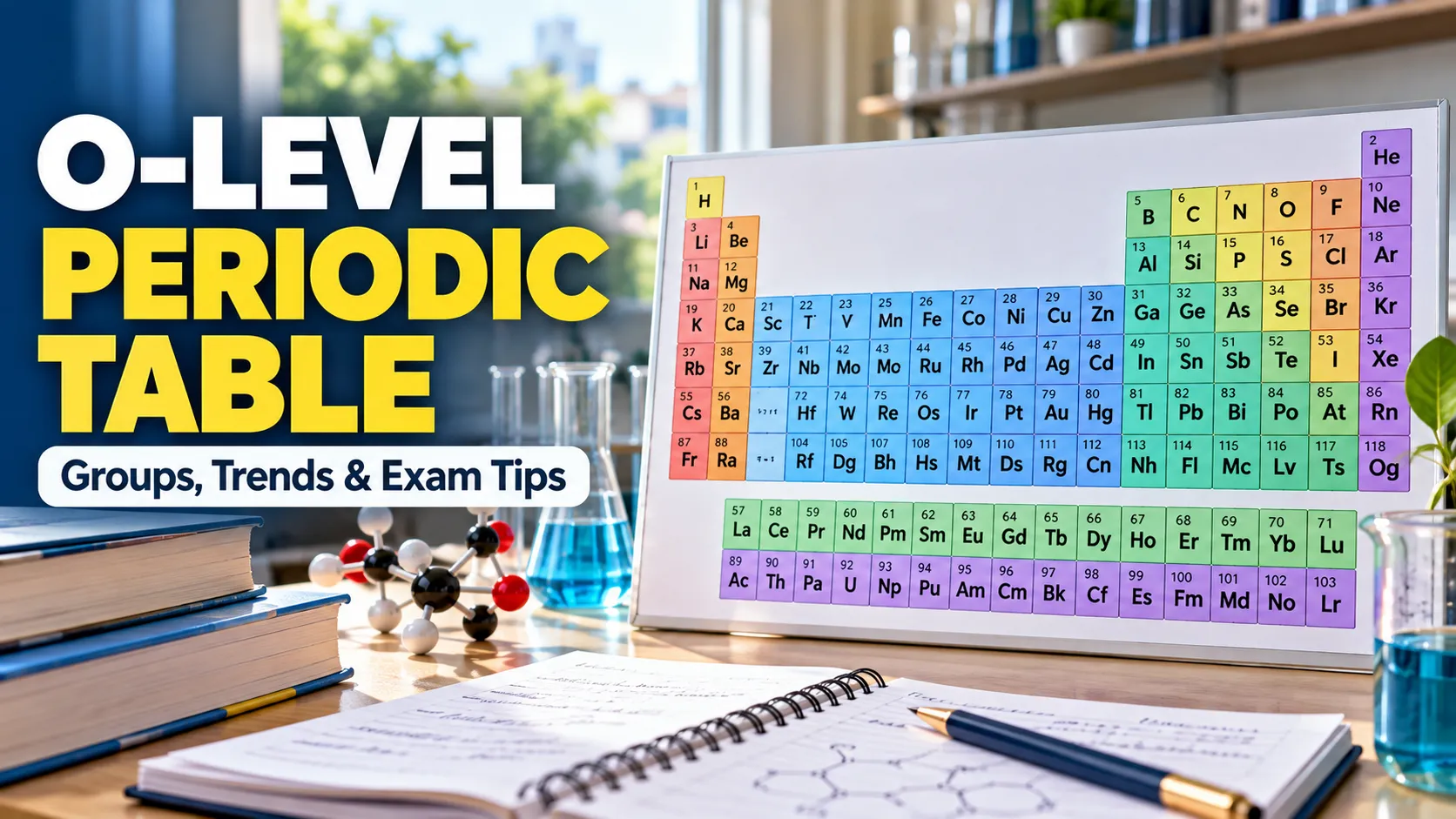
O-Level Periodic Table: How to Read It for Chemistry
Singapore-Cambridge O-Level Chemistry students need more than a chart filled with element symbols. The O-Level periodic table helps you work out an element’s electronic configuration, identify its group and period, and predict some of its chemical properties. Once you understand how the table is arranged, questions about sodium, chlorine and other elements become easier to answer. This guide explains the key features, important groups, reactivity trends and exam-style questions in a way you can use for Chemistry revision in Singapore.
TL;DR — O-Level Periodic Table at a Glance
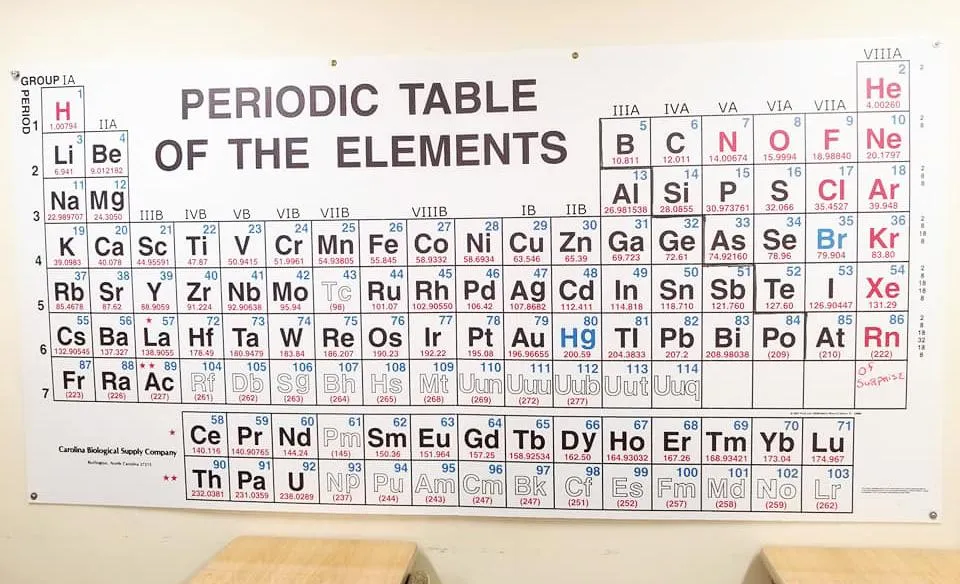
The periodic table arranges chemical elements in order of increasing atomic number. Vertical columns are called groups, while horizontal rows are periods. For main-group elements, the group helps identify the number of outer-shell electrons, and the period indicates the number of occupied electron shells. Use an element’s position alongside its electronic configuration to explain its properties.
O-Level Periodic Table Quick Reference Table
An O-Level periodic table chart contains useful information about chemical elements. Learn what each feature tells you rather than memorising the chart as a collection of symbols.
| Feature | Meaning | Example |
|---|---|---|
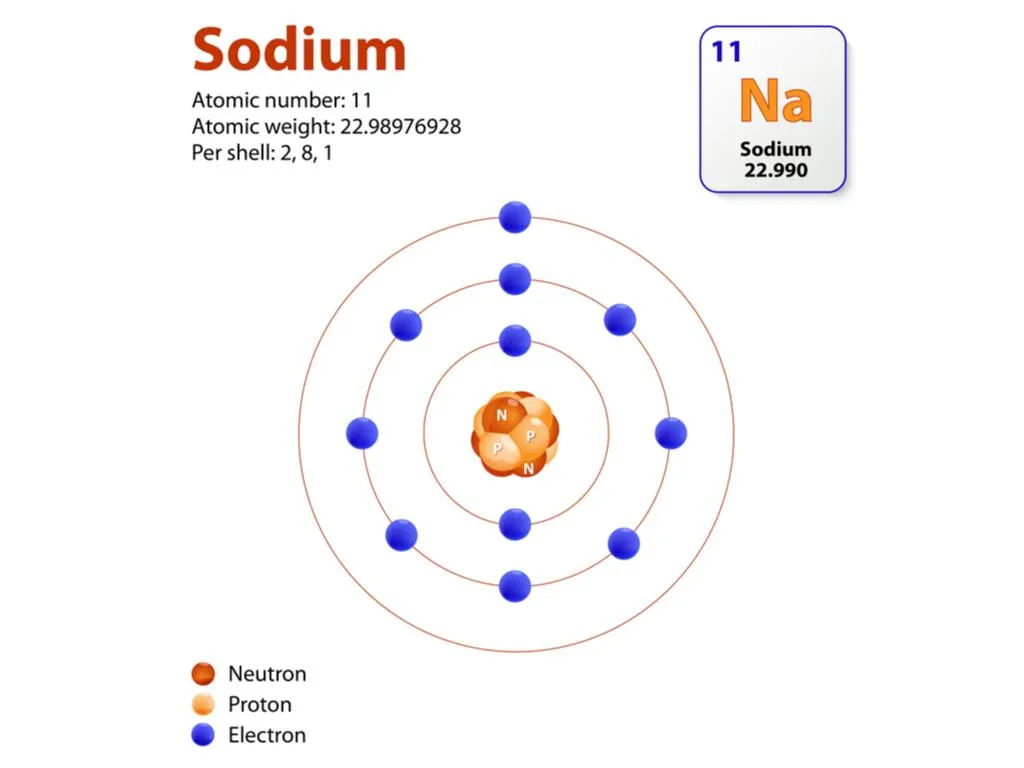
| Atomic number | Number of protons in the nucleus | Sodium: 11 |
| Chemical symbol | Short form used to represent an element | Sodium: Na |
| Group | Vertical column in the table | Sodium: Group 1 |
| Period | Horizontal row in the table | Sodium: Period 3 |
| Electron arrangement | Number of electrons in each occupied shell of an atom | Sodium: 2,8,1 |
| Relative atomic mass | Weighted average mass of an element’s atoms relative to carbon-12, as defined on the relative scale | Sodium: approximately 23 |
The atomic number identifies an element. Its chemical symbol is usually one or two letters, with the first letter capitalised and the second, if present, lowercase. In exam questions, check the information given in the element box carefully: atomic number and relative atomic mass describe different things.
How to Read the O-Level Periodic Table
Understanding an Element Box
An element box commonly displays its chemical symbol, atomic number and relative atomic mass. The layout can vary between charts, so check which number is labelled rather than relying only on its position. Take sodium (Na). Its atomic number is 11, so every sodium atom contains 11 protons. A neutral sodium atom also has 11 electrons. Its relative atomic mass is approximately 23, but this value is not its atomic number. The number of neutrons in a particular sodium-23 atom can be calculated by subtracting the proton number from the nucleon number: \(23-11=12\). Be careful with the terms used in the question, because relative atomic mass and nucleon number are not interchangeable.
Atomic Number and Electronic Configuration
To work out the electronic configuration of a neutral atom, use its atomic number to find the number of electrons, then arrange those electrons into shells according to the rules taught in your syllabus. Sodium has 11 electrons, giving an electronic configuration of 2,8,1. It has three occupied shells and one outer-shell electron. These details help explain why sodium is in Group 1 and Period 3. This is a useful method for how to read the periodic table for O-Level Chemistry: check the atomic number, write the electronic configuration, then connect the outer-shell electrons and occupied shells to the element’s position.
Groups and Periods in the Periodic Table
What Are Groups?
Groups are the vertical columns of the periodic table. Main-group elements in the same group generally have the same number of outer-shell electrons, which helps explain their similar chemical properties. For example, lithium, sodium and potassium are Group 1 elements. Chlorine, bromine and iodine are Group 17 elements. Their reactions differ in strength, but members of each group share patterns in their chemical behaviour.
What Are Periods?
Periods are the horizontal rows. For the elements commonly studied at O-Level, the period number tells you how many electron shells are occupied. Sodium has the electronic configuration 2,8,1, so it has three occupied shells and sits in Period 3. Magnesium, with the configuration 2,8,2, is also in Period 3.
| Feature | Groups | Periods |
|---|---|---|
| Direction | Vertical columns | Horizontal rows |
| Main clue | Outer-shell electrons for main-group elements | Number of occupied shells |
| Example | Sodium is in Group 1 | Sodium is in Period 3 |
When revising periodic table groups and periods, practise moving both ways: from electronic configuration to position, and from position to likely electronic structure.
Important Periodic Table Groups for O-Level Chemistry
Group 1 — Alkali Metals
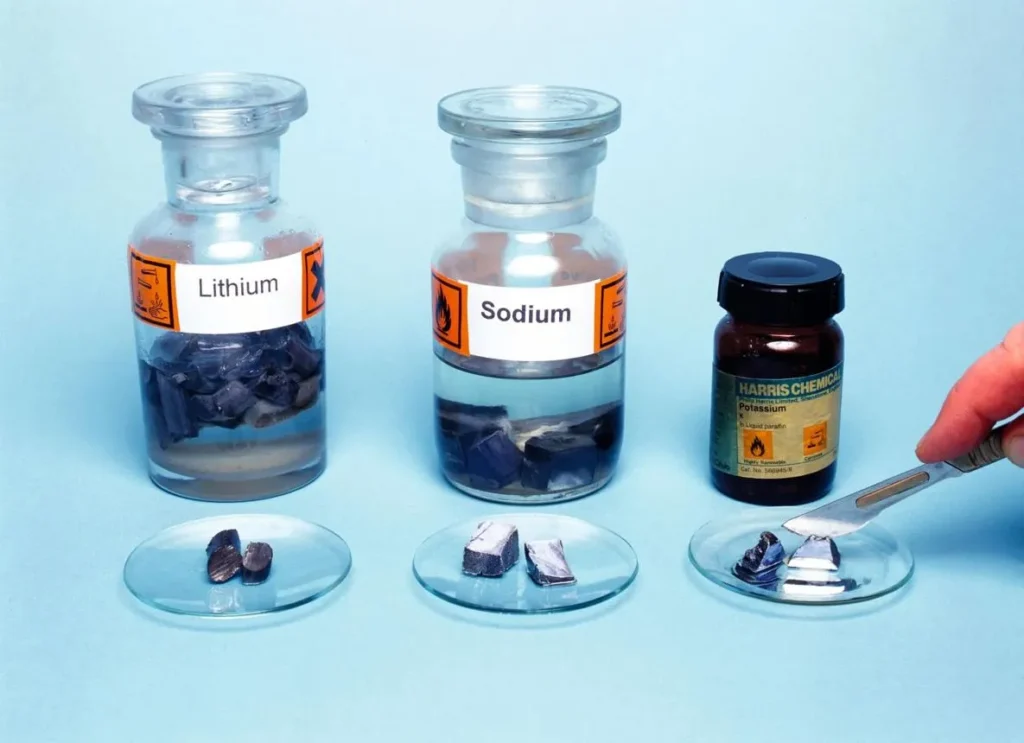
Lithium, sodium and potassium are soft metals that react with water to form an alkaline solution and hydrogen gas. Their reactivity generally increases down the group. Potassium reacts more vigorously than sodium, while lithium is less reactive than sodium. Each has one outer-shell electron. Down the group, this electron is farther from the nucleus and experiences greater shielding from inner electrons, so it is easier to lose during a reaction.
Group 17 — Halogens
Chlorine, bromine and iodine are non-metals known as halogens. At room temperature, chlorine is a gas, bromine is a liquid and iodine is a solid. Their colours also differ. Halogens react by gaining an electron. Their reactivity generally decreases down Group 17 because the incoming electron is farther from the nucleus and experiences greater shielding. This reduces the attraction for that electron.
Group 18 — Noble Gases
Helium, neon and argon are noble gases. They are very unreactive because their outer electron shells are stable. Helium has a full first shell, while neon and argon have full outer shells in the electron arrangements studied at this level.
Transition Elements
Transition elements are metals. Some form coloured compounds, and some act as catalysts. They can also show variable oxidation states. Study these features to the depth required by your current Singapore-Cambridge O-Level Chemistry syllabus; focus on the elements and properties specified for your course rather than trying to memorise every transition element. These groups are useful starting points for Singapore O-Level Chemistry revision, especially when a question asks you to compare properties or explain a reaction.
Periodic Trends You Should Understand
Periodic trends help you explain why elements in the same group behave in related ways. For O-Level Chemistry, learn the direction of each trend and the reason behind it. Simply memorising “increases” or “decreases” may not earn full marks if the question asks you to explain.
| Trend | Direction | Main reason |
|---|---|---|
| Group 1 reactivity | Generally increases down the group | The outer electron is farther from the nucleus and easier to lose |
| Group 17 reactivity | Generally decreases down the group | Greater distance and shielding reduce attraction for an incoming electron |
For Group 1 metals, losing one outer-shell electron forms a positive ion. As the atom gets larger down the group, the attraction between the nucleus and that electron becomes weaker, so the electron is lost more easily. For Group 17 halogens, gaining one electron is part of their reaction. Down the group, the incoming electron enters a shell farther from the nucleus and faces more shielding from inner electrons. The attraction is weaker, so the reaction becomes less favourable. These explanations link electronic structure with the periodic trends in O-Level Chemistry. Use the terms outer electron, shielding and attraction to the nucleus where they fit the question.
O-Level Periodic Table Exam Questions with Answers
Try these O-Level periodic table exam questions with answers before checking the explanations. They reflect the kind of reasoning used in school Chemistry practice. Question 1: Sodium has atomic number 11. What is its electron arrangement? Answer: 2,8,1. A neutral sodium atom has 11 electrons, arranged as two in the first shell, eight in the second and one in the third. Question 2: Why is sodium in Period 3? Answer: Its electron arrangement is 2,8,1, so it has three occupied electron shells. Question 3: Why do Group 1 elements have similar chemical properties? Answer: They have one electron in their outer shell. This gives them a similar tendency to lose one electron and form positive ions. Question 4: Why does halogen reactivity generally decrease down Group 17? Answer: The atoms become larger and shielding increases. The nucleus attracts an incoming electron less strongly, so gaining an electron becomes less favourable. For effective O-Level Chemistry practice questions, write the scientific reason after each answer. A correct trend with no explanation may not be enough for a question asking “why”.
Common Periodic Table Mistakes to Avoid
- Mixing up groups and periods: groups run vertically; periods run horizontally.
- Confusing atomic number with relative atomic mass: atomic number equals the number of protons.
- Applying the group rule to every element: the simple outer-electron pattern is most useful for main-group elements.
- Memorising trends without reasons: explain how distance, shielding and attraction affect reactivity.
- Skipping electronic configuration: use it to check an element’s group and period. A quick check of these points can prevent avoidable errors in structured questions.
Frequently Asked Questions
What is the O-Level periodic table?
The O-Level periodic table is a chart of chemical elements arranged by increasing atomic number. Its layout helps students relate an element’s electronic configuration to its position and chemical properties.
Do you need to memorise the periodic table for Singapore O-Level Chemistry?
For the 2026 Singapore-Cambridge O-Level Chemistry syllabus 6092, the official SEAB syllabus states that a copy of the Periodic Table of Elements is printed in both Paper 1 and Paper 2. You should still practise reading it and learn the group properties and trends required by your syllabus. Check the latest official SEAB Chemistry syllabus and exam instructions for your examination year.
How do you identify groups and periods from electronic configuration?
For the main-group examples taught at this level, the number of outer-shell electrons indicates the group, while the number of occupied shells indicates the period. For sodium, 2,8,1 gives Group 1 and Period 3.
Why do elements in the same group have similar properties?
Main-group elements in the same group have the same number of outer-shell electrons. Their atoms tend to react in related ways because those outer electrons take part in chemical reactions.
Where can you find an O-Level periodic table chart or PDF?
Start with the official SEAB 2026 Chemistry syllabus PDF, which confirms the exam’s periodic-table provision. For revision, use a clear chart that shows element symbols, atomic numbers and relative atomic masses. Practise with the chart format used in your school materials.
Conclusion
The O-Level periodic table becomes easier to use once you connect an element’s atomic number, electronic configuration, group and period. Practise explaining Group 1 and Group 17 reactivity with scientific reasons, then test yourself with syllabus-based questions. A few short revision sessions can make these patterns much easier to recall.

Global Arena is a Singapore-focused SEO and digital marketing brand with a network of 25+ publisher websites, helping businesses strengthen their online presence through guest posting, link building, content marketing, and digital PR.
For collaborations, publishing opportunities, or business inquiries:
Hamza@globalarena.org | WhatsApp: +971 52 399 4589