
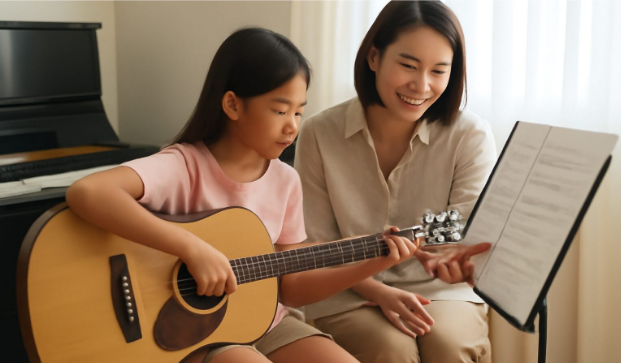
How Music Education Helps Children Build Confidence and Social Skills
Many parents sign children up to learn a skill, music. They tend to see the first change, which is in personality. A quiet child begins to voice his opinion and a shy boy or girl begins to do something different.
Music education works on more than the ears and fingers. It encourages children to practise regularly, perform in front of others and play along with other children. All these experiences shape a different facet of their personality.
The impact is most noticeable in confidence and social skills. Children develop confidence in their capabilities and they learn to deal with other people. These behaviors begin in the music room, but they are in evidence in school, at home, and with friends. Here are eight ways how music helps children build confidence and social skills.
1. It Builds Self-Belief Through Small Wins
The process of learning an instrument is composed of small achievements. A child sings the first note, a short tune, and a whole tune.
They see that with effort comes progress with each step. This pride is seen within weeks by parents who enrolled their children in music lessons in Singapore studios. A child who says “I can’t” begins to say “let me try again.”
That attitude can often rub off on schoolwork or sports.
2. It Teaches Children to Handle Mistakes
All musicians make mistakes. A good teacher uses these moments to learn instead of to see them as failure.
Children are taught to stop, correct the mistake and go on. This builds resilience. They start to understand the concept of mistakes as feedback.
It gives them a positive outlook in life for overcoming challenges outside of music.
3. It Reduces the Fear of Performing in Front of Others
A short piece played to the teacher is a safe start. Children then perform in a recital for their family, peers or a select group of friends.
All performances build upon each other. With practice, stage fright can be controlled. Nervousness and success go together with children.
This experience will be beneficial for school presentations and classroom conversation.
4. It Encourages Teamwork in Group Settings
For choirs, bands and ensembles, everyone must play their part. The entire piece may not be carried by one player.
The kids develop synchrony and become attuned to one another. They also see that what they do does count, even if it is small.
Lessons of cooperation are difficult to impart by words alone.
5. It Improves Listening and Communication
Music teaches children to be good listeners. They listen for pitch, rhythm and volume, and respond to them.
They listen to other players in an ensemble as well. This is a good habit to develop that can help them to be better listeners in conversations. Good listening skills lead to more thoughtful responses from children.
Students’ vocabulary and expression is also expanded through conversations with teachers and classmates about music.
6. It Develops Patience and Discipline
Practice makes progress in music. It takes a child a whole afternoon to learn a piece.
Routine and focus are developed through regular practice. Children are taught to plan and follow through on small targets. They also learn to wait for the results.
A child feels more confident when he or she knows that effort is rewarded.
7. It Helps Children Make Friends
Music provides a common bond of interest. Children in the same group/class can have a conversation about it immediately.
They gather regularly for rehearsals, recitals and practice sessions. It’s often more comfortable for shy children to relate to people through music than to engage in conversation.
Many of these friendships endure beyond the lessons.
8. It Gives Children a Skill They Can Share
A musical ability is a talent a child may possess to share with others. They can perform during family outings, school functions, or gatherings with friends. Learn piano Singapore programmes provide children with social benefits through private or group lessons. Piano is also an excellent choice to start with, as it helps teach rhythm, music reading, and coordination.
Giving children something to do creates a sense of purpose through sharing music. They know they are appreciated for their abilities.
Final Thoughts
The whole child is supported through music education. It is a mixture of confidence in a gradual build up and confidence in social skills through shared play. Music instruction provides children with lifelong tools. Become more willing to do things differently and collaborate with others.
Parents do not need to aim for a professional musician. The real reward is a child who feels capable and connects well with people.

Global Arena is a Singapore-focused SEO and digital marketing brand with a network of 25+ publisher websites, helping businesses strengthen their online presence through guest posting, link building, content marketing, and digital PR.
For collaborations, publishing opportunities, or business inquiries:
Hamza@globalarena.org | WhatsApp: +971 52 399 4589